
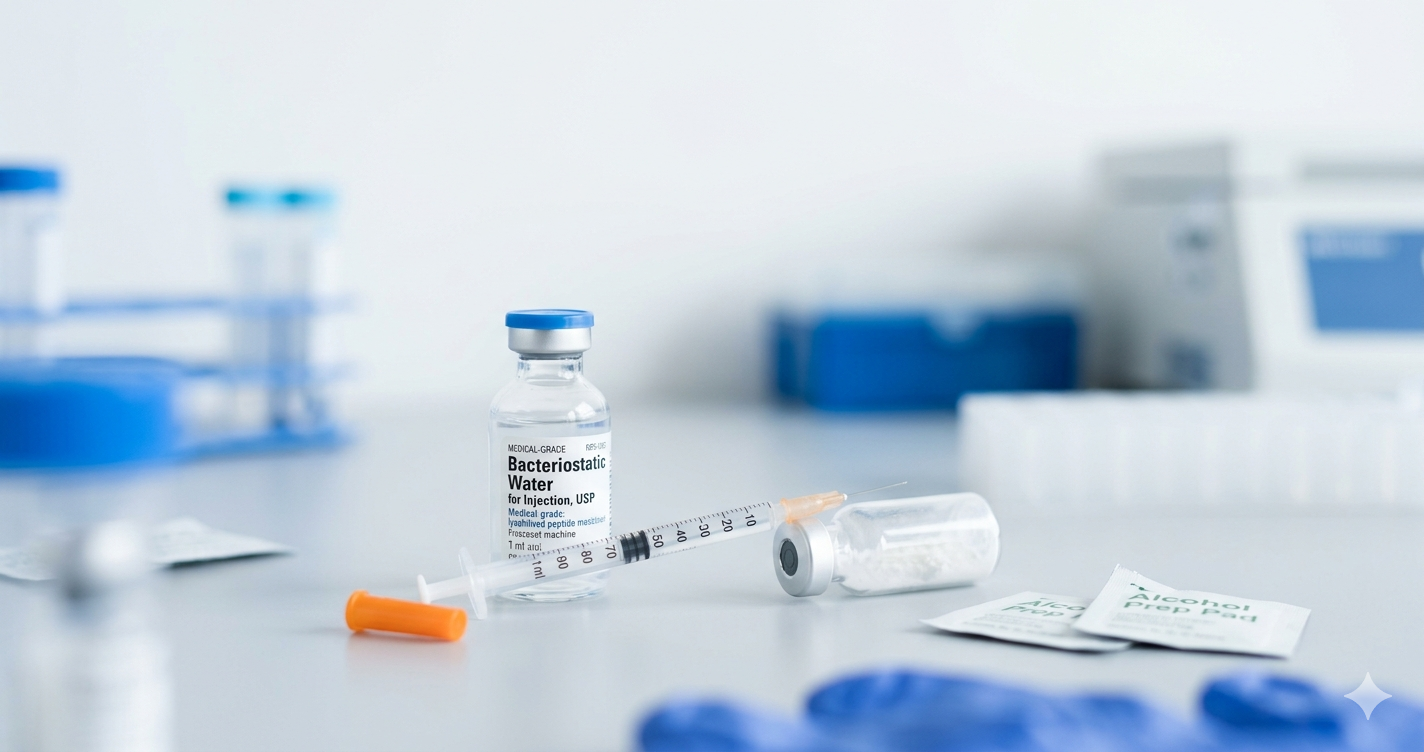
Essential Bacteriostatic Water Guide: 5 Critical Tips for Peptide Reconstitution
If you’re new to peptide research, you’ve probably seen the term bacteriostatic water — often shortened to “bac water” — and wondered what makes it special.
Can’t you just use regular tap water? Distilled water? Saline?
The short answer is no. Using the wrong diluent can destroy your research compounds, introduce contaminants, or fail to preserve them for repeated use.
This guide covers everything researchers need to know about bacteriostatic water: what it is, why it matters, how to use it, and best practices for storage and handling.
Let’s dive in.
What Is Bacteriostatic Water?
Bacteriostatic water (often called “bac water”) is sterile water that contains 0.9% benzyl alcohol as a preservative.
| Feature | Detail |
|---|---|
| Composition | 0.9% benzyl alcohol + sterile water for injection |
| Purpose | Prevents bacterial growth in multi-dose vials |
| Appearance | Clear, colorless, no particles |
| pH Range | 4.5-7.0 (typically) |
| Use | Reconstituting lyophilized peptides for research |
The key difference between bacteriostatic water and other sterile waters is the benzyl alcohol preservative, which allows the vial to be used multiple times over several weeks without bacterial contamination.
Why Bacteriostatic Water Matters for Peptide Research
Peptides are delicate molecules. They’re supplied as lyophilized (freeze-dried) powder to remain stable during storage and shipping. Before research use, they must be reconstituted — mixed with a liquid to return them to a soluble state.
What Happens If You Use the Wrong Diluent?
| Diluent | Safe for Peptides? | Why |
|---|---|---|
| Tap water | ❌ No | Contains chlorine, minerals, and potential bacteria |
| Distilled water | ❌ No | Not sterile; no preservative → bacteria growth |
| Saline (0.9% NaCl) | ⚠️ Maybe | Sterile but no preservative → use immediately |
| Sterile water (no preservative) | ⚠️ Maybe | Must be used immediately; discard after single use |
| Bacteriostatic water | ✅ Yes | Sterile + preservative for multi-dose use |
The Preservative Advantage
Benzyl alcohol inhibits bacterial growth in the vial after the first puncture. This means researchers can:
- Draw multiple doses from the same vial over days or weeks
- Store reconstituted peptides safely in the refrigerator
- Reduce waste (no need to discard unused peptide after one use)
- benzyl alcohol preserving
Without benzyl alcohol, any bacterial contamination introduced by a needle puncture can multiply — potentially compromising your research.
How to Reconstitute Peptides with Bacteriostatic Water
Step-by-Step Protocol
Step 1: Gather supplies
- Lyophilized peptide vial
- Bacteriostatic water vial
- 1ml insulin syringe (27-31 gauge)
- Alcohol wipes
Step 2: Clean all surfaces
- Wipe the rubber stopper of both vials with an alcohol wipe
- Allow to dry completely (5-10 seconds)
Step 3: Draw air into syringe
- Pull back plunger to the amount of bac water you’ll add (e.g., 1ml)
- This equalizes pressure when injecting into the peptide vial
Step 4: Inject air into bac water vial
- Insert needle into bacteriostatic water vial
- Inject the air (this prevents vacuum when withdrawing)
Step 5: Draw bacteriostatic water
- Invert the bac water vial
- Withdraw your desired amount (e.g., 1ml)
- Remove needle
Step 6: Inject into peptide vial
- Insert needle into peptide vial at a 45-60° angle
- Inject the bac water slowly down the side of the vial — never directly onto the powder (this can damage peptides)
Step 7: Gently swirl
- Do NOT shake (can damage peptide structure)
- Gently swirl until the solution is clear and all powder is dissolved
- BPC-157
Step 8: Refrigerate
- Store reconstituted peptide in the refrigerator (2-8°C)
- Label with date of reconstitution
- aseptic technique guidelines
Dosage Calculation: The Simple Formula
Once your peptide is reconstituted, you need to calculate how much to draw for your desired dosage.
The Formula
Dosage drawn (ml) = Desired dose (mcg) ÷ Concentration (mcg per ml)
Concentration Formula
Concentration (mcg/ml) = Peptide amount (mg × 1000) ÷ Total liquid (ml)
Example: 10mg Vial Reconstituted with 2ml Bac Water
| Step | Calculation |
|---|---|
| 1. Convert mg to mcg | 10mg × 1000 = 10,000mcg |
| 2. Calculate concentration | 10,000mcg ÷ 2ml = 5,000mcg per ml |
| 3. Desired dose: 500mcg | 500mcg ÷ 5,000mcg = 0.1ml (or 10 units on insulin syringe) |
| 4. Desired dose: 250mcg | 250mcg ÷ 5,000mcg = 0.05ml (or 5 units) |
Quick Reference Table (10mg vial, 2ml bac water)
| Desired Dose (mcg) | Units on 1ml syringe |
|---|---|
| 250mcg | 5 units (0.05ml) |
| 500mcg | 10 units (0.1ml) |
| 750mcg | 15 units (0.15ml) |
| 1000mcg (1mg) | 20 units (0.2ml) |
Storage & Handling Best Practices
Before Reconstitution (Lyophilized Powder)
| Condition | Recommendation |
|---|---|
| Temperature | Refrigerator (2-8°C) or freezer (-20°C) |
| Protection | Keep away from light and heat |
| Shelf life | 12-24 months from manufacture |
After Reconstitution
| Condition | Recommendation |
|---|---|
| Temperature | Refrigerator ONLY (2-8°C) — never freeze |
| Protection | Keep away from light |
| Use by | 30 days (typically) — always check product label |
| Discard | Any solution that appears cloudy or has visible particles |
Important: Do NOT Freeze Reconstituted Peptides
Freezing reconstituted peptides can:
- ❌ Damage peptide structure (ice crystals)
- ❌ Alter concentration as ice forms
- ❌ Accelerate degradation upon thawing
Signs Your Bacteriostatic Water May Be Compromised
- Cloudy appearance
- Visible particles floating in solution
- Unusual color (should be clear)
- Expired beyond labeled date
- peptide storage research
Common Questions About Bacteriostatic Water
Can I use sterile water instead of bacteriostatic water?
Technically yes — but only for single-use applications where the entire reconstituted volume is used immediately and the vial is discarded. For multi-dose research protocols, bacteriostatic water is essential to prevent bacterial growth.
How long does reconstituted peptide last?
Typically 30 days when stored properly in the refrigerator. However, always follow the specific recommendations for your research compound. Some peptides are more stable than others.
Can I reuse bacteriostatic water vials after opening?
Yes — that’s the point of the preservative. Each vial can be punctured multiple times over several weeks. Always wipe the stopper with an alcohol wipe before each use.
What if I use too much or too little bacteriostatic water?
- Too much bac water → Lower concentration. You’ll need to inject larger volumes (e.g., 2ml instead of 0.5ml). This is generally fine but may be less convenient.
- Too little bac water → Higher concentration. This may affect solubility and could cause precipitation. Always follow solubility guidelines for your specific peptide.
Can I mix multiple peptides in the same syringe with bac water?
Sometimes, but it’s not generally recommended for research applications. Mixing peptides in the same syringe may cause:
- Compatibility issues (some peptides degrade each other)
- Inaccurate dosing (difficult to verify)
- Precipitate formation
For accurate research, use separate syringes for each peptide compound.
Is bacteriostatic water the same as sterile water for injection?
No. Sterile water for injection contains no preservative. It’s designed for single-use only. Bacteriostatic water contains 0.9% benzyl alcohol for multi-dose use.
Safety & Regulatory Information
For Research Use Only
Bacteriostatic water — like all products on this site — is intended for laboratory research use only. It is not approved for human injection, medical use, or pharmaceutical applications.
Benzyl Alcohol Warning
Benzyl alcohol is not for use in research protocols involving neonatal or pediatric models unless specifically designed for such studies.
Proper Disposal
Discard expired or compromised bacteriostatic water and reconstituted peptide solutions according to applicable laboratory waste regulations.
The Bottom Line
Bacteriostatic water is an essential tool for peptide research. Its preservative allows for multi-dose use — making it practical for typical research protocols.
| Key Takeaway | Why It Matters |
|---|---|
| 0.9% benzyl alcohol | Prevents bacterial growth in multi-dose vials |
| Proper reconstitution | Preserves peptide structure and accuracy |
| Refrigerate after mixing | Maintains stability for up to 30 days |
| Never freeze reconstituted peptides | Prevents damage from ice crystals |
For researchers who use peptides requiring reconstitution, high-quality bacteriostatic water is not optional — it’s essential.
Ready for Your Research?
If you’re preparing for peptide research, we offer sterile bacteriostatic water (0.9% benzyl alcohol) for laboratory use only. Each vial is manufactured under strict quality controls.
For research use only. Not for human consumption or medical use.
Have questions about reconstitution or peptide handling? Check out our detailed peptide guides or reach out to our team.