KPV Peptide
In the world of peptide research, some compounds grab headlines for their size or complexity. Others—like KPV—prove that sometimes, the most powerful tools come in small packages.
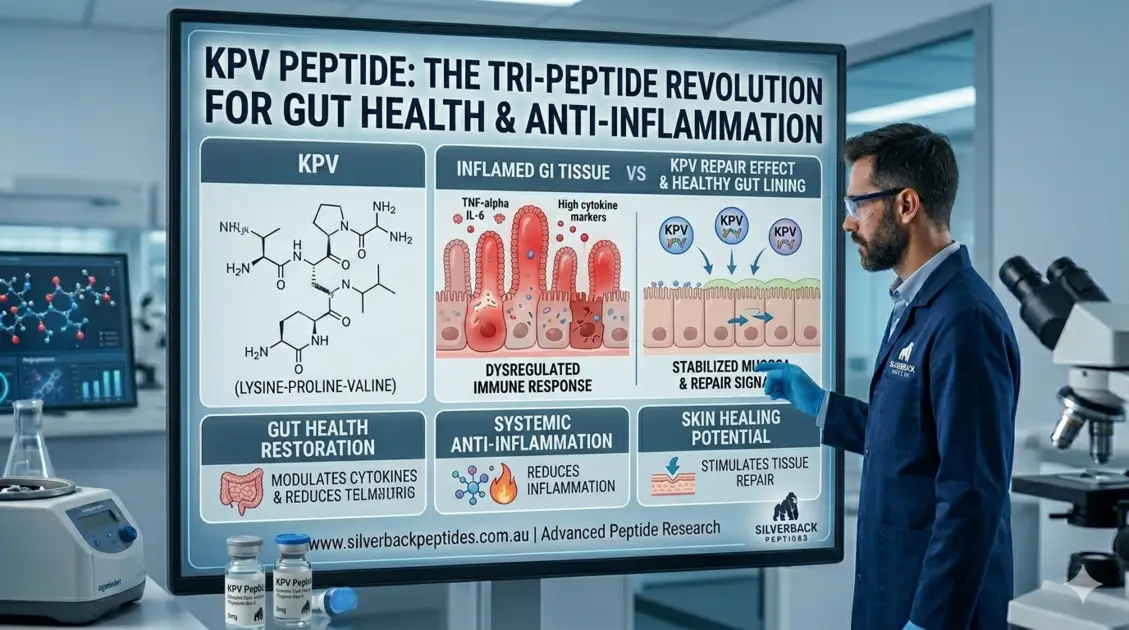
KPV is a tripeptide consisting of just three amino acids: lysine, proline, and valine. Don’t let its size fool you. This small molecule has been the subject of significant research for its potent anti-inflammatory, antimicrobial, and immunomodulatory properties.
Originally derived from alpha-melanocyte-stimulating hormone (α-MSH), KPV represents one of the most promising areas of peptide science: isolating the active fragments of larger proteins to target specific pathways with remarkable precision.
Let’s dive into the research.
What Is KPV?
KPV is a tripeptide fragment derived from the C-terminal end of alpha-melanocyte-stimulating hormone (α-MSH) . “For researchers studying this compound, [KPV 10mg is available for laboratory use] .” While α-MSH is known for its role in pigmentation, researchers discovered that its anti-inflammatory activity is concentrated in this small three-amino-acid sequence.
| Component | Amino Acid | Role |
|---|---|---|
| K | Lysine | Involved in immune signaling |
| P | Proline | Structural stability |
| V | Valine | Supports tissue repair |
By isolating this fragment, researchers can study the anti-inflammatory and immunomodulatory effects of α-MSH without the hormonal activity associated with the full molecule .
How Does KPV Work?
KPV’s mechanism of action is multifaceted. Unlike many anti-inflammatory compounds that target a single pathway, KPV appears to work through multiple mechanisms simultaneously:
1. Inhibition of Pro-Inflammatory Cytokines
KPV has been shown to significantly reduce the production of key inflammatory markers including:
- TNF-α (tumor necrosis factor-alpha)
- IL-1β (interleukin-1 beta)
- IL-6 (interleukin-6)
- IL-8 (interleukin-8)
These cytokines are central to the inflammatory cascade, and their overproduction is implicated in a wide range of inflammatory conditions .
2. NF-κB Pathway Modulation
KPV inhibits the activation of NF-κB (nuclear factor kappa-light-chain-enhancer of activated B cells)—a protein complex that controls transcription of DNA and plays a critical role in regulating the immune response to infection . When NF-κB is overactivated, it contributes to chronic inflammation and autoimmune responses.
3. Antimicrobial Activity
Research suggests KPV possesses direct antimicrobial properties against certain bacterial strains, including Staphylococcus aureus and Escherichia coli . This dual anti-inflammatory and antimicrobial profile makes it particularly interesting for researchers studying conditions involving both infection and inflammation.
4. Gut Barrier Protection
KPV has been shown to help maintain intestinal barrier integrity—a critical factor in conditions like leaky gut and inflammatory bowel disease . It appears to support tight junction proteins that keep the gut lining intact.
Key Research Areas
Inflammatory Bowel Disease (IBD)
Multiple studies have investigated KPV for inflammatory bowel conditions:
- In animal models of colitis, KPV treatment significantly reduced disease activity, colonic inflammation, and tissue damage. “Researchers interested in exploring KPV’s effects on inflammatory conditions can [find HPLC-verified KPV here] .”
- The peptide was shown to downregulate pro-inflammatory cytokines while preserving the epithelial barrier
- Some research suggests KPV may be as effective as certain corticosteroids in reducing inflammation—without the associated side effects
Skin Inflammation & Wound Healing
KPV has shown promise in dermatological research:
- Topical application of KPV reduced inflammation in models of contact dermatitis and psoriasis
- The peptide promotes keratinocyte proliferation and migration, supporting wound healing
- Its antimicrobial properties may help prevent wound infections
Gastrointestinal Health
Beyond IBD, KPV is being studied for:
- Peptic ulcers: KPV reduced gastric damage in models of stress-induced ulceration
- Chemotherapy-induced mucositis: Research suggests KPV may help protect the intestinal lining during chemotherapy
- Food allergies: Early studies indicate KPV may help modulate immune responses to food allergens
Metabolic Health
Emerging research suggests KPV may influence:
- Insulin sensitivity through its effects on systemic inflammation
- Adipose tissue inflammation, which is linked to metabolic syndrome
KPV vs. Other Anti-Inflammatory Peptides
| Peptide | Primary Action | Best For |
|---|---|---|
| KPV | Multi-pathway anti-inflammatory | Gut inflammation, skin conditions, immune modulation |
| BPC-157 | Tissue repair, angiogenesis | Tendon healing, gut permeability, wound repair |
| GHK-Cu | Skin regeneration, collagen synthesis | Anti-aging, wound healing, hair research |
| Thymosin Beta-4 | Cell migration, tissue repair | Injury recovery, heart repair, anti-fibrotic |
KPV’s advantage lies in its potent anti-inflammatory activity combined with direct antimicrobial effects—a unique combination not found in most other peptides .
Practical Considerations for Researchers
Form & Administration
KPV is typically supplied as a lyophilized powder for reconstitution:
“Ready to add KPV to your research protocols? [Shop KPV 10mg now] .”
- Form: Available in 10mg or 50mg vials
- Reconstitution: Use bacteriostatic water
- Administration: Subcutaneous injection for systemic research; topical formulations for dermatological studies
- Oral potential: Some research explores oral KPV for gut-targeted effects
Storage
- Store lyophilized powder in the refrigerator (2-8°C)
- After reconstitution, refrigerate and use within 30 days
- Protect from light
Dosage Considerations
Based on published research:
- Typical dosing ranges from 100-500mcg per day in animal models
- Cycle lengths vary, but 2-4 week protocols are common
- Individual responses vary significantly
What KPV Is NOT
Let’s clear up a few misconceptions:
- Not a painkiller: While it reduces inflammation (which can reduce pain), KPV is not an analgesic
- Not an immunosuppressant: It modulates inflammation without broadly suppressing immune function
- Not a steroid: Its mechanism is entirely different from corticosteroids
- Not a quick fix: Like most peptides, KPV works over time to modulate underlying inflammatory processes
The Future of KPV Research
KPV represents a fascinating intersection of peptide science and immunology. By isolating the active anti-inflammatory fragment of α-MSH, researchers have created a tool that may help untangle the complex relationships between:
- Inflammation and gut health
- Immune modulation and tissue repair
- Microbial balance and inflammatory signaling
As research continues, KPV may help answer fundamental questions about how small peptides can orchestrate complex immune responses—and what that means for developing targeted therapies for inflammatory conditions .
The Bottom Line
KPV is proof that big things come in small packages. This simple tripeptide, derived from a larger hormone, has demonstrated remarkable anti-inflammatory and immunomodulatory properties across multiple research contexts.
For researchers studying inflammation, gut health, skin conditions, or immune modulation, KPV offers a well-characterized, mechanism-driven tool with a growing body of supporting literature.
Want to Learn More?
If you’re interested in researching KPV, we offer HPLC-verified KPV 10mg for laboratory use only. Each batch is tested for purity and comes with a Certificate of Analysis.
For research use only. Not for human consumption or medical use.
Have questions about KPV or other research peptides? Drop a comment below or reach out to our team.