Peptide handling
You just received your vial. It’s beautiful. Lyophilized powder staring back at you like a tiny science experiment.
Now what?
Here’s the thing nobody tells you when you’re starting out: how you handle peptides matters as much as which peptides you choose.
I’ve watched researchers spend hundreds on quality compounds only to destroy them through rookie mistakes. Leaving them on the counter overnight. Using the wrong water. Dosing blind because they couldn’t do basic math.
This isn’t complicated stuff. But it’s essential stuff. Think of it as driver’s education before you get behind the wheel.
Let’s walk through everything you need to know—from unboxing to first dose.
First, A Quick Reality Check
Peptides are fragile.
They’re chains of amino acids, carefully folded into specific shapes that fit specific receptors. Heat destroys that shape. Light degrades it. Vigorous shaking? Think earthquake in a china shop.
Your job as a researcher is simple: keep the peptide intact until the moment it enters your body.
That’s it. That’s the whole game.
Part 1: Reconstitution (The Art of Waking Peptides Up)
Your peptide arrived as a lyophilized powder—freeze-dried and stable. Think of it as Sleeping Beauty. Reconstitution is the kiss that wakes it up.
What You’ll Need:
- Bacteriostatic water (sterile water with 0.9% benzyl alcohol)
- Insulin syringes (easy to measure small volumes)
- Alcohol wipes
- Your peptide vial
Why bacteriostatic water matters: Regular sterile water works once. But bacteriostatic water contains a tiny amount of alcohol that prevents bacterial growth, meaning you can use the same vial for multiple doses over several weeks. It’s the difference between a one-night stand and a relationship.
The Step-by-Step:
Step 1: Sanitize everything
Wipe the rubber stopper on your peptide vial with an alcohol wipe. Do the same with your bacteriostatic water vial. Let them dry. Alcohol needs about 30 seconds to actually kill things.
Step 2: Draw your water
Pull air into your syringe (same volume as the water you’ll draw). Insert into bacteriostatic water vial, inject the air (creates pressure, makes drawing easier), then draw your desired amount of water.
Step 3: Inject into peptide vial
Insert needle into peptide vial at an angle (prevents coring—little chunks of rubber in your precious powder). Slowly inject the water against the inside glass wall, not directly onto the powder.
This matters. Direct jets can damage peptides. Be gentle. Let the water run down the side like you’re pouring a fine whiskey.
Step 4: Swirl, don’t shake
Once all water is in, gently swirl the vial until powder dissolves completely. Do not shake. Shaking creates bubbles and mechanical stress. Treat it like a snow globe you don’t want to agitate.
Step 5: Inspect
Clear solution? No floating particles? Good. Cloudy or particulate? Something went wrong—don’t use it.
How Much Water to Add?
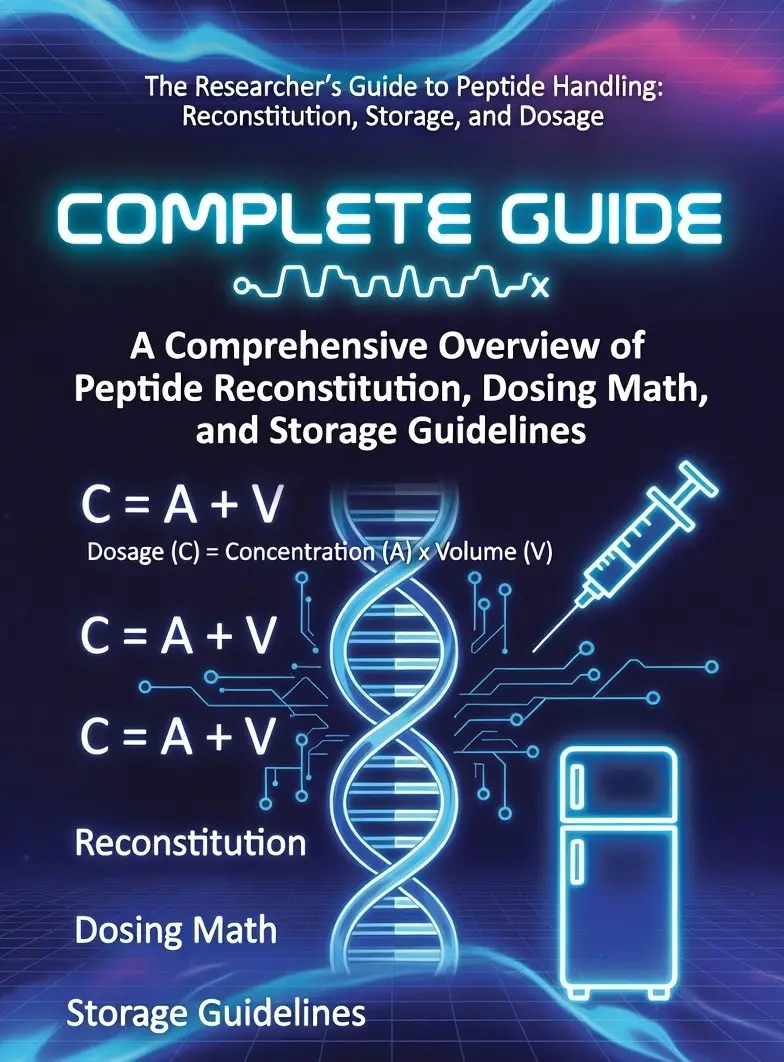
This depends on your desired concentration. Here’s the simple formula:
Amount of water (mL) = Desired dose volume (mL) × Number of doses
But that’s abstract. Let’s use a real example:
You have a 5mg vial of BPC-157. You want each dose to be 250mcg (0.25mg), and you want to inject 0.1mL (10 units on an insulin syringe) per dose.
Math time:
- 5mg = 5000mcg
- 5000mcg ÷ 250mcg per dose = 20 doses
- If each dose is 0.1mL, total water needed = 20 × 0.1mL = 2mL
So add 2mL bacteriostatic water. Then 0.1mL of your reconstituted solution contains exactly 250mcg.
Pro tip: There are peptide dosage calculators online. Use them. Your future self will thank you.
Part 2: Storage (Keeping Your Investment Alive)
Before Reconstitution (Lyophilized Powder)
- Freezer is fine (-20°C/-4°F) for long-term storage
- Keep dry—moisture is the enemy
- Light protection—amber vials exist for a reason
- Stable for months, sometimes years, if stored properly
After Reconstitution (In Solution)
This is where peptides become high-maintenance.
- Refrigerator only (2-8°C / 35-46°F). Never freeze liquid peptides—ice crystals destroy structure.
- Most peptides last 2-4 weeks in solution before gradual degradation
- Bacteriostatic water helps, but it’s not magic. The benzyl alcohol prevents bacterial growth but doesn’t stop the peptide from slowly breaking down.
- Write dates on vials with a sharpie. “Reconstituted 3/2/26.” Memory is unreliable. Labels aren’t.
The “Oh No” Moments to Avoid
Leaving it in a hot car: Instant peptide graveyard. 60°C (140°F) destroys most peptides in minutes.
Freeze-thaw cycles: If you freeze liquid peptide, then thaw it, then refreeze? Each cycle causes damage. Don’t do this.
Direct sunlight: Peptides aren’t vampires, but they share the sun aversion. Amber vials help; keeping them in the fridge drawer helps more.
Part 3: Dosage (Where Math Meets Biology)
Reading Your Vial
Every vial should list total peptide content. Usually in milligrams (mg).
- 5mg = 5000 micrograms (mcg)
- 2mg = 2000mcg
- 10mg = 10,000mcg
Most peptide doses fall in the mcg range (100-1000mcg), not mg range. This trips up beginners constantly.
Insulin Syringe Basics
Insulin syringes measure in “units,” not mL or mg. This confuses everyone at first.
Standard insulin syringe: 100 units = 1mL
So:
- 10 units = 0.1mL
- 20 units = 0.2mL
- 30 units = 0.3mL
Your dose is always: Draw X units = Y mcg of peptide
The Dosage Formula
Here’s the universal formula:
(Total mg in vial) ÷ (mL of water added) = mg per mL
Then convert mg to mcg (multiply by 1000) to get mcg per mL.
Then divide by 10 to get mcg per unit (since 1 unit = 0.02mL? Wait, let me slow down.)
Better to walk through an example:
Example: 5mg vial + 2mL water
- 5mg ÷ 2mL = 2.5mg per mL
- 2.5mg × 1000 = 2500mcg per mL
- 1mL = 100 units, so 2500mcg ÷ 100 = 25mcg per unit
So if you want 250mcg: 250 ÷ 25 = 10 units
Double-check: 10 units × 25mcg/unit = 250mcg. Perfect.
Common Dosing Ranges (Always Research Your Own)
| Peptide | Typical Single Dose | Frequency |
|---|---|---|
| BPC-157 | 250-500mcg | 1-2x daily |
| Ipamorelin | 200-300mcg | 1-3x daily |
| CJC-1295 (no DAC) | 100-200mcg | 1-2x daily |
| MOTS-c | 5-10mg | 3-5x weekly |
| TB-500 | 2.5-5mg | 2-3x weekly |
These are ranges, not recommendations. Your research should determine your protocol.
Part 4: Injection Basics (The Moment of Truth)
Subcutaneous (SubQ) 101
Most peptides are injected subcutaneously—into the fatty tissue just under the skin. Not muscle. Not vein.
Best spots:
- Stomach (2 inches away from belly button)
- Love handles
- Back of arm (if someone else is injecting)
- Upper thigh
The technique:
- Clean injection site with alcohol wipe. Let dry.
- Pinch a fold of skin.
- Insert needle at 45-degree angle.
- Inject slowly.
- Withdraw needle.
- Apply light pressure with sterile gauze (no rubbing).
Rotate sites. Same spot every time leads to lumps and reduced absorption. Keep a mental map.
Common Mistakes
Not letting alcohol dry: Injecting through wet alcohol stings. Badly. Wait 30 seconds.
Going too deep: SubQ means under skin but above muscle. If you hit muscle, you might know it—more pain, faster absorption, different kinetics.
Reusing needles: Just don’t. They’re cheap. Infections aren’t.
Air bubbles: Small ones (like 1-2 units) won’t hurt you subQ. Large ones? Flick the syringe to move them up, then push them out before injecting.
Part 5: Troubleshooting Common Issues
“My peptide won’t dissolve fully”
Possible causes:
- Old peptide (degraded)
- Wrong pH (rare with bacteriostatic water)
- Contamination
If gentle swirling and room temperature doesn’t help within 10-15 minutes, something’s wrong. Don’t inject particulate matter.
“It stings when I inject”
Could be:
- Alcohol not dry
- Peptide concentration too high (some peptides sting at high doses)
- Benzyl alcohol sensitivity (rare)
- Poor injection technique
Try more dilution next time. Ensure alcohol dries completely. Go slower.
“I forgot to refrigerate overnight”
If it’s less than 12 hours and room temperature wasn’t extreme (under 25°C/77°F), it’s probably fine but potency may be slightly reduced. If it got hot or sat out for days? Cut your losses. Not worth injecting degraded mystery liquid.
“I added too much water”
No problem. Your concentration is just lower. You’ll inject larger volume for same dose. That’s fine as long as volume is reasonable (under 0.5-0.8mL per site).
“I added too little water”
Your concentration is higher. Dosing becomes tricky—tiny volumes are hard to measure accurately. Add more bacteriostatic water to fix. Math adjusts accordingly.
The Safety Section (Read This Twice)
Sterility Is Not Optional
- Always wipe vial tops before drawing
- Never touch needle tip
- One needle per draw, one per injection
- If you drop a needle, replace it
Sharps Disposal
Used needles go in a sharps container. Not trash. Not recycling. Not “carefully wrapped in a water bottle.”
Most pharmacies sell small sharps containers. Some communities have disposal programs. Do not make sanitation workers handle your research waste.
When in Doubt, Throw It Out
Cloudy solution? Toss it.
Particulate matter? Toss it.
Expired? Toss it.
Questionable storage? Toss it.
Peptides aren’t cheap, but infections and abscesses are much more expensive.
The Golden Rules of Peptide Handling
Let’s boil this whole guide down to what matters:
- Be gentle—swirl, don’t shake
- Keep cool—refrigerate after reconstitution
- Stay sterile—alcohol wipes are your friend
- Do the math—calculate before you inject
- Label everything—dates, concentrations, peptide names
- Rotate sites—give your skin a break
- Document your research—what worked, what didn’t
What Questions Do You Have?
Here’s what I’m genuinely curious about:
What’s tripped you up with peptide handling? Reconstitution confusion? Dosage math disasters? Storage screw-ups?
Or maybe you’re preparing for your first research cycle and have questions I didn’t cover.
Drop a comment below or reach out directly. These practical skills matter more than which peptide you choose, and the best knowledge comes from shared experience.
Let’s help each other research smarter.
*New to peptides? Start with our Peptides 101 guide. Ready for specific compounds? Check out our deep dives on BPC-157, Ipamorelin & CJC-1295, and MOTS-c.*