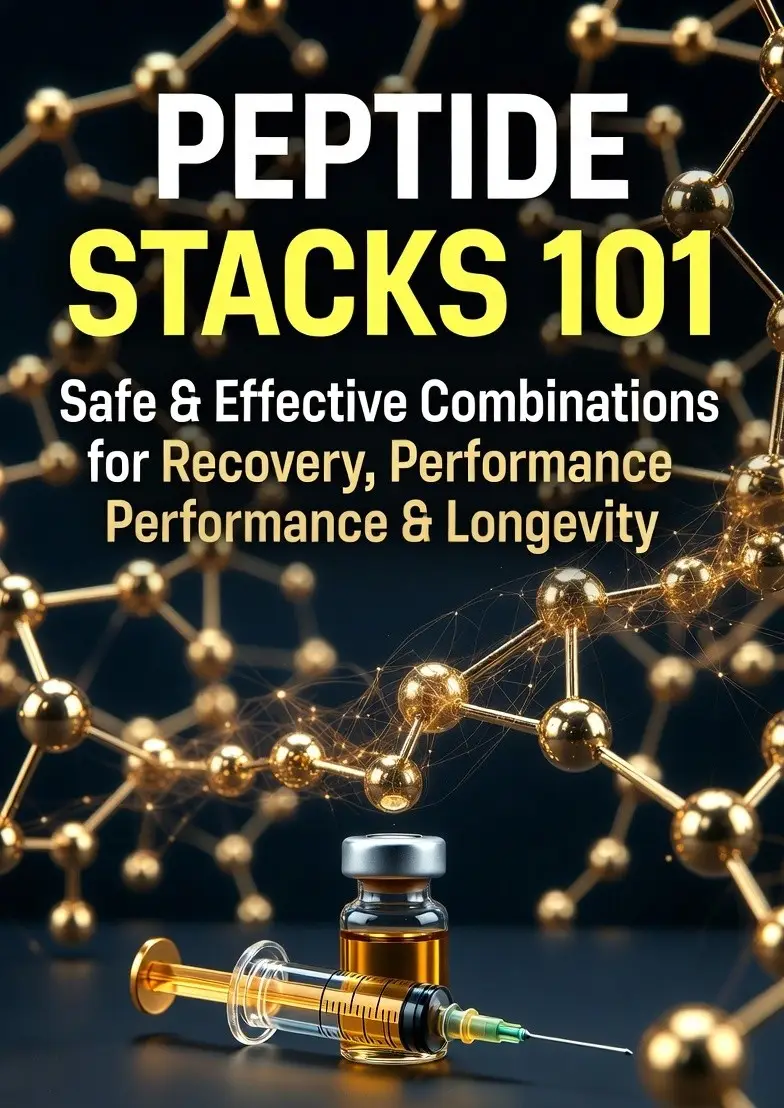
So you’ve mastered the singles. Now you’re eyeing the doubles.
I get it.
After reading about BPC-157 for healing, Ipamorelin for recovery, and MOTS-c for mitochondrial health, a question naturally bubbles up: “What if I used more than one?”
Welcome to the world of peptide stacks.
Combining peptides is like moving from playing guitar in your bedroom to joining a band. More complexity, more potential, but also more ways to hit a wrong note. Done right, stacks create synergy—the famous “1+1=3” effect. Done wrong? You’re just throwing expensive compounds at your body and hoping something sticks.
Let’s talk about how to do this intelligently.
First, Forget Everything Movies Taught You About Stacking
Pop culture vision: “I’ll take ALL the supplements. MEGA DOSE. MAXIMUM GAINS.”
Reality: Your body isn’t a petri dish, and more isn’t better.
Peptides work through specific receptors and signaling pathways. Throw too many at once and you’re not optimizing—you’re just creating noise. Worse, some peptides can actually compete with each other or blunt each other’s effects.
The goal of intelligent stacking isn’t maximum volume. It’s strategic synergy.
The Golden Rules of Peptide Stacking
Before we get into specific combinations, let’s establish some ground rules. These keep researchers out of trouble:
Rule #1: Master Singles Before Stacks
If you haven’t run BPC-157 alone, don’t stack it with anything yet. You need to know how you respond to each compound individually. What are your side effects? What timing works for you? What results do you see?
A stack obscures all that. If something goes wrong, which peptide caused it? If results are amazing, which one deserves credit? You won’t know.
Run each peptide solo first. Take notes. Then consider combinations.
Rule #2: Understand Half-Lives
Peptides hang around for different durations.
- Some (like CJC-1295 with DAC) last days
- Others (like Ipamorelin) clear in hours
- Some (like BPC-157) have short active windows
Stacking without considering half-lives means you might dose everything simultaneously and wonder why your protocol feels uneven. Map out the timing. Know when each peptide peaks and when it fades.
Rule #3: Target Different Pathways
The best stacks hit different biological mechanisms.
Why? Because if two peptides do the same thing, they’re competing—not complementing. You’re just taking a higher dose of one effect with extra steps.
Good stacks pair:
- A growth hormone secretagogue with a growth hormone releasing hormone (different points in the same pathway)
- A healing peptide with a performance peptide (different goals that support each other)
- A metabolic peptide with a recovery peptide (foundation + expression)
Rule #4: Start Low, Go Slow
When combining, cut individual doses by 20-30% initially.
Even if you tolerated 300mcg of Ipamorelin alone, start at 200mcg in a stack. The synergy means you might need less total compound, not more. You can always titrate up. You can’t untake a dose.
Rule #5: Change One Variable at a Time
When adjusting a stack, never change multiple peptides simultaneously.
Want to increase the CJC dose? Keep everything else identical for two weeks. Observe. Then consider the next adjustment. This is basic scientific method applied to your own research.
The Classic Stacks That Keep Coming Up
Let’s look at some well-established combinations researchers actually use:
Stack #1: The Growth Hormone Optimizer
Components: Ipamorelin + CJC-1295 (no DAC)
Why it works: This is the synergistic pair we covered in the last post. Ipamorelin stimulates the pulse. CJC-1295 amplifies it. Together, they create a stronger GH release than either alone. GH research
Best for: Recovery, sleep quality, body composition shifts
Typical protocol: Both dosed together before bed, 5-7 days per week
Research note: This is arguably the most documented peptide stack in existence. It’s the entry point for most people moving into combinations.
Stack #2: The Healer + Performer
Components: BPC-157 + Ipamorelin/CJC (or another GH secretagogue)
Why it works: BPC-157 handles local tissue repair while the GH stack supports systemic recovery and regeneration. The healing peptide works on the injury; the growth hormone support creates an optimal environment for that healing to happen.
Best for: Coming back from injuries, post-surgery recovery, chronic issues that won’t resolve
Typical protocol: BPC-157 dosed near injury site (or systemically) twice daily; GH stack dosed before bed
Research note: Many researchers report that injuries which stalled with BPC-157 alone finally resolved when they added GH support. The combination addresses both the site and the system.
Stack #3: The Metabolic + Recovery
Components: MOTS-c + Ipamorelin/CJC
Why it works: MOTS-c optimizes mitochondrial function and metabolic health—the foundation of cellular energy. The GH stack then uses that improved energy system for recovery and regeneration. Better mitochondria mean better recovery.
Best for: Researchers focused on both performance and longevity; metabolic health + body composition
Typical protocol: MOTS-c dosed in the morning (aligns with metabolic rhythms); GH stack before bed
Research note: This is a newer stack but makes physiological sense. You’re essentially upgrading your cellular energy production and telling your body to use that energy for recovery.
Stack #4: The Comprehensive Repair
Components: BPC-157 + TB-500
Why it works: BPC-157 is the project manager for repair. TB-500 is the construction crew that increases blood flow, cell migration, and tissue building. Together, they create a powerful healing environment.
Best for: Significant injuries, surgical recovery, stubborn soft tissue damage
Typical protocol: Both dosed together, often twice daily, around the injury site
Research note: This is a heavy-duty stack. Not for minor tweaks. Researchers save this for situations where standard healing has failed.
Stacks to Approach with Caution
Not every combination is smart. Here are some to think twice about:
The “Everything But The Kitchen Sink” Stack
Five peptides. All dosed simultaneously. No clear rationale.
This isn’t research—it’s hope disguised as protocol. Pick a primary goal and stack toward that. Save other goals for future cycles.
Competing GH Secretagogues
Stacking multiple GHRPs (like Ipamorelin + GHRP-2 + GHRP-6) doesn’t create synergy. It creates receptor saturation and desensitization. Pick one GHRP, pair it with a GHRH, and call it done.
Long-Acting + Short-Acting Without Timing
CJC-1295 with DAC lasts over a week. Tossing short-acting peptides on top without considering that timeline means you’re dosing into an unpredictable hormonal environment. Know your half-lives.
The Practical Side: Reconstitution and Mixing
Here’s a question I get constantly:
“Can I mix peptides in the same syringe?”
Short answer: Sometimes. Longer answer: It’s complicated.
Some peptides are compatible in solution. Others degrade each other. BPC-157 and TB-500 are often mixed successfully. Growth hormone peptides usually prefer their own syringes. Bacteriostatic Water
If you’re unsure: separate syringes, separate injection sites. It’s slightly more inconvenient and infinitely safer than destroying expensive research compounds through incompatibility.
When in doubt, the peptide community’s unofficial motto applies: Inject separately, stack intelligently.
The Most Important Stacking Advice
Here’s the thing nobody tells you about stacking.
The best stack in the world won’t fix broken fundamentals.
If you’re sleeping five hours a night, eating processed garbage, and training like a maniac without periodization, no combination of peptides will save you. They’ll just be expensive passengers on a sinking ship.
Peptides support what you’re already doing right. They don’t rescue what you’re doing wrong.
So before you design the perfect stack, ask yourself:
- Is my sleep actually dialed?
- Is my nutrition supporting my goals?
- Is my training intelligent and appropriate?
- Is my stress managed (or at least acknowledged)?
Get those right. Then let peptides amplify the signal.
Sample Stacking Worksheet
If you’re designing your own stack, here’s a simple framework:
| Question | Your Answer |
|---|---|
| Primary goal (one sentence) | |
| Peptides that address this goal | |
| Their individual half-lives | |
| Their optimal timing | |
| Potential interactions | |
| Starting doses (20-30% below solo) | |
| How will you track progress? |
Run through this before mixing anything. It takes ten minutes and saves months of wasted research.
The Bottom Line
Peptide stacking isn’t magic. It’s applied physiology with a dash of experimentation.
The researchers who get the best results aren’t the ones taking the most compounds. They’re the ones who understand why each peptide belongs in their protocol, how they interact, and what signal they’re sending to their bodies.
Start simple. Document everything. Adjust slowly.
And remember: the goal isn’t the most complex stack. It’s the right stack for your goals.
What’s Your Stacking Experience?
Here’s what I’m genuinely curious about:
Have you experimented with peptide stacks? What combinations have you researched, and what did you observe?
Or maybe you’re considering your first stack and have questions about compatibility or timing.
Drop a comment below or reach out directly. The collective knowledge in this community is incredible, and the best protocols emerge from conversation, not isolation.
Let’s learn from each other.
New to peptides? Start with our Peptides 101 guide before diving into stacks. Foundation first, then complexity.